Southern Thailand has two weather seasons.
High season begins in November and features higher percentage
occupancy in hotels and higher prices for goods and services.
In Phuket, the change in prices can be pretty dramatic. The
weather is generally clear and sunny.
The coolest weather is in late December
through early January. Peak high season is the Christmas-New
Year period. It's crowded and more expensive.
Paddle Asia trips are, however, never
crowded. Our trips are limited to 2 to 6 guests. Bigger group
trips are available if booked as a group.
Low season, or the monsoon season, features
wind predominantly from the southwest. Storms which originate
in Antarctica, pass by Sumatra on the way to Phuket and Phang
Nga Bay.
The bay is actually sheltered by Phuket, so
even if there is fairly bad weather on the west side of
Phuket, Phang Nga Bay can be calm.
Phuket Rainy Season
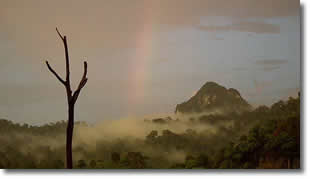
What if it rains? Rain does not detract from
your paddling experience. Brief rains, which are the
norm, actually enhance it. Both Phang Nga Bay and Khao Sok get
more mystical in the rain.
If there is rain, it is normally passing
quickly. If there is lightning, we will go to a beach or
get on the longtail escort boat until it passes. This
too seldom lasts long.
Phang Nga Bay Kayaking Weather
Cloudy
days are cooler, making paddling more comfortable. Conditions
often change by the hour. We put on sun screen in the morning
and watch approaching rain fronts in the afternoon. It's
beautiful!
The good news is that Paddle Asia specializes in finding
out-of-the-way destinations. We much prefer to see the natural
world sans the crowds!
What is the Monsoon?
The word monsoon most likely comes from the Arabic word mausim,
which literally means season.
The monsoon is the seasonal wind reversal. It is not the rain
as commonly assumed. Rain is the byproduct of this wind. For
half of the year, the wind comes from one direction and for
the other half, it comes from the direct opposite direction.
 From about mid April
through October and into November a bit, the predominant wind
direction on the Malay Peninsula is from the southwest. For
the rest of the year, the wind shifts to coming from the
northeast.
From about mid April
through October and into November a bit, the predominant wind
direction on the Malay Peninsula is from the southwest. For
the rest of the year, the wind shifts to coming from the
northeast.
The western side of the Malay Peninsula—the side that has
Phuket, Krabi, Trang and Tarutao—gets more rain during the
summer months. The eastern side—the side with Koh Samui, Koh
Pang Ngan, Koh Tao and Koh Chang—is drier during this time.
The wind is coming from the southwest. The wind direction
shifts in November and the seasons change. During the winter
months, the eastern coastline of the Malay Peninsula gets less
rain.
The tourist high season on the eastern side of the Malay
Peninsula is from about November through the middle of April.
This is the low season for tourism in the Gulf of Thailand
side (Ko Samui).
Don't let a little rain prevent you from enjoying either side of the Malay Peninsula.
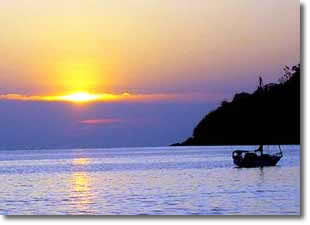
Low season means cheaper prices on almost everything, fewer tourists,
rainbows, and awesome sunsets.


