The Geology of Phang Nga Bay - Phang Nga Bay is part of what was once a huge coral
reef that covered much
of what is now Southeast Asia. The islands of Phang Nga Bay were formed by the movements of massive
slabs of earth called
"plates". These plates, however, were underwater. They were part of the coral reef. They were lifted out
of the seas by
the movement of the plates.
Our sea
canoeing trips in Phang Nga Bay include visits to a couple of sea caves. On 3 and 4 day
trips one day
is Krabi cave kayaking in the far northeast corner of the bay.
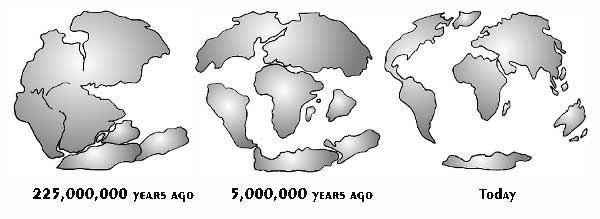
The formation of karst mountains - The Greek word "tektonickos" means to construct. At
one point in
history, about 200,000,000 years ago, the continents were connected.
One of the explanations used to support the theory
is the "continental jigsaw" argument. The continents "fit" together (see drawing below). Continental
geology is another
reason. The rock layers match where continents were thought to be joined before. And finally, there are
fossils of ancient
life forms on separate continents that would not live in the same region as they lay today.
These plates shift and move on the lower layers. All of the layers are in motion
relative to each
other. The consequence of this motion is collision. Incidentally, almost all volcanic, seismic
(earthquake), and
orogenic (mountain building) activities go on along the boundaries created by these collisions.
Plates move in 3 different methods
Away from each other, called Divergent
Toward each other, called Convergent
Slide past each other, called Transform plate
Limestone
Limestone is sedimentary rock. About 8% of the earth's surface is sedimentary rock.
Fossils are a
distinguishing feature of sedimentary rock. However, fossils can be found in other types of rocks too.
Non-marine origin limestone occurs due to diagenesis ("dia" is Greek for "through".
"Genesis" is Greek
for beginning or origin). Sediments are deposited initially as unconsolidated debris. Consolidation
comes about gradually due
to dewatering (not in the type of limestone in Phang Nga Bay) and/or because of cementing with a binding
material (clay,
calcium, lime). The rock is altered and gradually changes into limestone through this process called
diagenesis. Rocks that
have become solid in this way are described by ending with the word "stone". Like, limestone, mudstone,
and sandstone.
Almost all sedimentary rockis layered. Reef limestone is generally
not layered.
They develop as an atoll or fringing reef. Lime is continuously deposited by the coral animal (polyps).
Pure limestone is snow white. Other colors are caused by other rocks:
Limonite and siderite cause yellow-brown shades
Hematite causes red
Glauconite and chlorite cause green
Bitumen causes gray to black
Limestone of marine origin
This limestone is a monomineralic (one mineral) rock consisting of a single mineral
(calcite) which
can make up 95% of the rock. Other rocks found in marine limestone include dolomite, siderite, quartz,
feldspar, mica,
and various clay materials.
Fragments from the hard parts of marine animals and plants, the parts which contain
calcium, form the
sediment. The main sources of calcium come from algae, corals, calcareous sponges, foraminiferids
(certain plankton), bryozoa
(moss animals) , brachiopods (lampshells) , echinoderms (starfish, sea urchins, sea cucumbers, sea
lilies) , mollusks
(snails, bivalves, chitons, octopus, squid) , crustacea (barnacles, lobsters, crabs, shrimp) , and
pteropods (some
snails, sea slugs, abalone, cowries, limpets).
When they die, they leave behind either complete units or skeletons. Sometimes the
former organism is
recognizable (fossils). Other times, it is completely broken down.
Limestone sea caves
Karst is limestone that features internal drainage. Most areas that have karst
formations also have
heavy rainfall and a thick bed of limestone with a lot of underground flowing water.
Dissolution caves are formed by dissolving limestone. These are generally the largest
caves with the most
interesting features, including some of the most interesting mineral deposits.
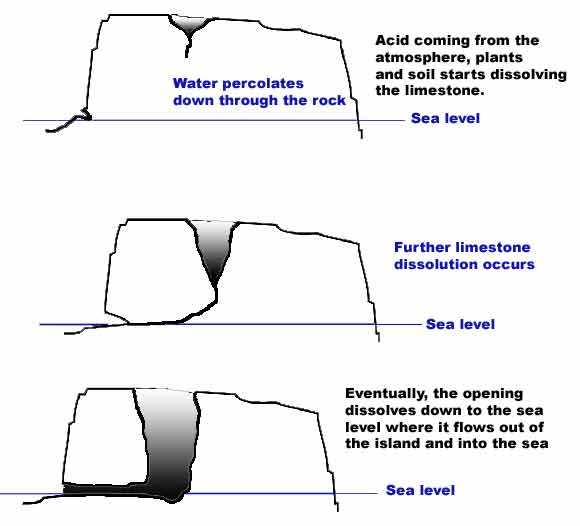
Acid dissolves the mineral calcite which is the primary elemental in limestone. Pure
water is not acidic
and therefore doesn't dissolve limestone. However, the atmosphere contains carbon dioxide. As rain fall,
it picks up
some of this CO2 and becomes acidic. Due to the biological activities involved in soil production, there
are high levels
of CO2 in the soil. When rain combines with soil, it therefore becomes more acidic.
Water sets in pools on top of the islands. It percolates down through cracks in the
rocks. It dissolves
limestone as it goes, thus enlarging the cracks.
The sides of this "sink hole" erode and dissolve. If a sea cave happens to connect
with this hole, the
enlarging process is sped up by the action of the sea water.
The Famous sea canoe Hong of southern Thailand
There are certainly many hidden "hongs" in the islands that are not accessible by sea
canoe since they
don't connect with a cave. The only way into these sink holes is from the top.
Paddle Asia avoids the well known hongs of Phang Nga Bay as they have become too
popular. Day trip
tourists from Phuket visit these hongs in mass. There are actually traffic jams in the caves! It's far
from being a
nature tour.
We do go into some hongs, which are just as stunning as the famous ones, and they are
not visited by others.